
UK heating engineers are increasingly considering expanding their business into heat pump installations, according to a recent Baxi survey.
More than half (59%) of UK heating engineers are either already, or likely to, work with other companies to develop heat pump competencies, according to heating and hot water solutions provider Baxi’s fourth annual Installer Skills survey.
Despite this interest in being prepared, a lack of consumer demand remains the number one barrier to heat pump uptake, the survey found, with 60% of installers citing this as an issue. The survey’s findings highlight the challenge of converting installer interest into real-world installations.
The 2025 survey showed that attitudes of some segments of the heating engineer population are becoming more sceptical of heat pumps and towards net zero more broadly, reflecting the increasingly divisive narratives on the topic from across the political spectrum.
The survey – conducted with green supply chain consultancy Talan (formerly Gemserv) – gathered responses from almost 400 installers.
Confidence growing as training makes its mark
The study found that the majority of installer operators are either sole traders or very small businesses with just two or three employees, with a growing trend to partner with other companies that can provide complimentary services, such as system design, installation support or financing.
The number of installers citing a lack of training as a barrier has fallen by 18% compared with 2024, suggesting that industry investment in heat pump and renewables training is beginning to pay off. Baxi alone has seen more than 1,000 installers attend its own heat pump training courses over the last 12 months.
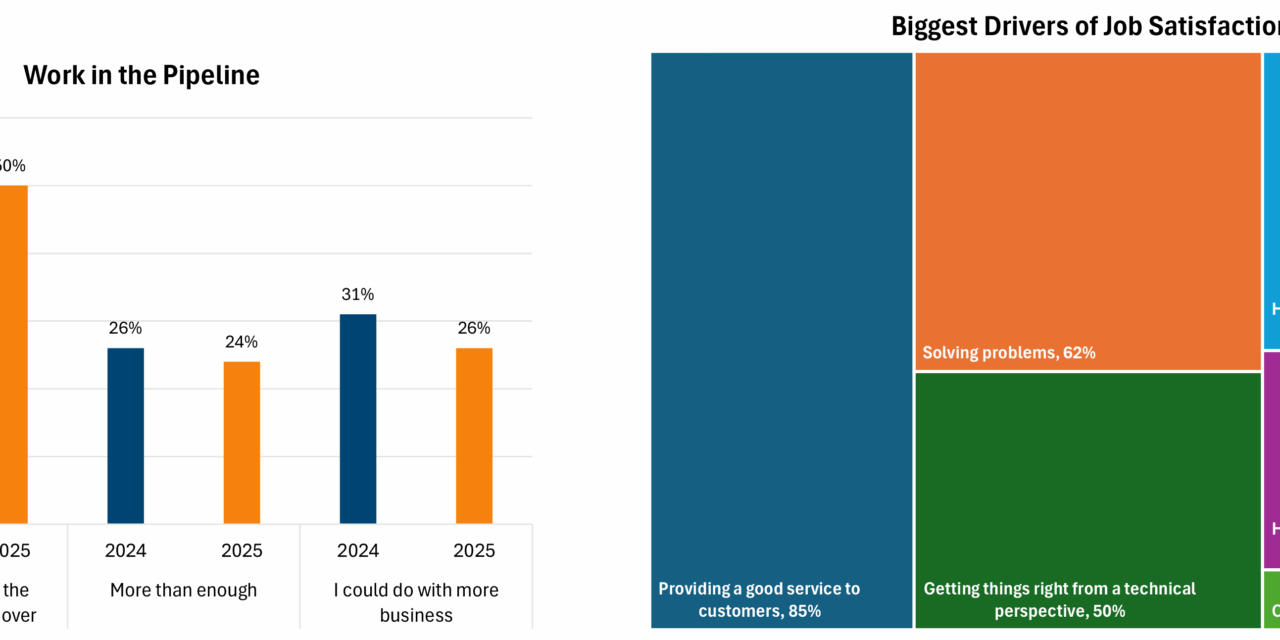
When asked what drives them in their work, the heating engineers most frequently cited providing a good service to customers (85%), solving technical problems (62%), and getting things right from a technical perspective (50%). According to Baxi, this professionalism partly explains why some installers hesitate to recommend new technologies until they feel fully competent.
“Installers clearly want to do the right thing for their customers,” says Ian Trott, Head of Training at Baxi UK. “Many take pride in their technical ability and won’t compromise on service until they’ve built real hands-on experience with the technology. Training for a qualification is one thing, but training for competence is what’s really needed.”
Hybrids seen as a practical bridge
The 2025 survey also found that 35% of installers have, or would be, somewhat or extremely likely to move to fitting heat pumps as part of a hybrid system, where a heat pump works alongside an existing combi boiler, rather than as a full heat pump-only replacement. Unlike a standalone heat pump system, hybrids typically do not require a water cylinder, making the installation lower cost, quicker, less disruptive and with less complexity for the installer.
“Hybrids can be a powerful transitional step,” Ian says. “They are often more attractive to installers because they’re easier to fit, and to customers because they require less cost and disruption. Research shows a well-installed hybrid system can cut a home’s heating carbon footprint by around 70% a year or more. Supporting hybrids would give more installers valuable real-world experience and help homeowners see the benefits earlier.”
Paperwork and demand
While attitudes to heat pumps have shifted positively, consumer demand is developing more slowly. Although many households continue to prefer a straightforward like-for-like boiler replacement, 2024 was still a record
year for UK heat pump sales.
Almost half of respondents (46%) named the paperwork involved in government schemes as a major obstacle to installing heat pumps, saying it slows down projects and can deter customers from making the switch.
The generational divide
A recurring theme in Baxi’s annual surveys has been a generational divide in attitudes to retraining. Installers approaching retirement are less inclined to invest in developing new skills, while those earlier in their careers are more open to diversifying their expertise.
The survey also noted that a large proportion of UK heat installers work either as sole traders or in very small teams. This can make it more difficult for them to take time out for training or to manage the additional paperwork that often accompanies low-carbon installations. Many respondents said they expect to collaborate or partner with other service providers to meet future demand for clean heat technologies.
“These findings show that despite some hardening of opinions most gas boiler installers aren’t dogmatic about technology and just want to do a good job for their customers,” says Will Taylor, Principal Consultant at Talan.
“Many installers are preparing for the future, with plans to prepare for the uptake of heat pumps and develop their skills. As a result, more installers are comfortable talking to their customers about energy efficiency and fewer say that training is a barrier than in last year’s study. It shows that the work the sector is doing to encourage training is working.”
As the transition to cleaner heating accelerates, installers are expected to play a central role in guiding customers through their choices and in ensuring new technologies are fitted competently to a high standard. Almost 400 installers took part in this year’s survey, which was conducted in July and August 2025.