Hamid Salimi explains why upskilling to heat pump installations presents a clear commercial opportunity for heating and plumbing professionals.
The growing heat pump market has been given a further boost by the Government’s recent extension of the Boiler Upgrade Scheme, which will soon cover air-to-air heat pumps for the first time. Homeowners will be able to claim grants on air-to-air heat pump systems capable of both heating and cooling, improving affordability and widening the range of properties where heat pumps are a viable option. For installers, this policy shift creates fresh commercial opportunities at a time when demand for low-carbon heating is accelerating.
Government targets call for 450,000 heat pump installations per year by 2030 – a dramatic increase from pre-2020 levels. Yet the number of qualified installers remains far short of what will be required to deliver that ambition. For established heating and plumbing businesses, this skills gap represents a clear opportunity: those who upskill now will be well positioned to secure work, command competitive pricing and future-proof their businesses.

Core knowledge
For many installers, the move into heat pumps is less of a step change than it may initially appear. Gas Safe-registered engineers already possess much of the core knowledge required, from system design and hydraulic principles to commissioning, fault finding and customer communication. These skills transfer directly to installing heat pumps. What is required is targeted training that builds on existing experience and addresses the specific considerations of low-carbon heating, rather than starting from first principles.
This is why practical, installer-focused training is so important. Courses that combine theory with hands-on experience, using working systems, allow engineers to understand how heat pumps perform in real-world conditions, while making use of the expertise they have built over years in the industry. Crucially, the most effective programmes are designed to fit around existing businesses, keeping time away from site to a minimum and enabling installers to add heat pumps to their offering without disrupting established revenue streams.
Government funding
Government funding has also helped remove one of the traditional barriers to upskilling. Fully funded or subsidised training now makes it possible for installers to achieve the qualifications required for MCS certification without significant upfront cost. This certification is essential for accessing schemes such as the Boiler Upgrade Scheme and plays a key role in reassuring customers that installations meet industry standards.
Heat pump bootcamp
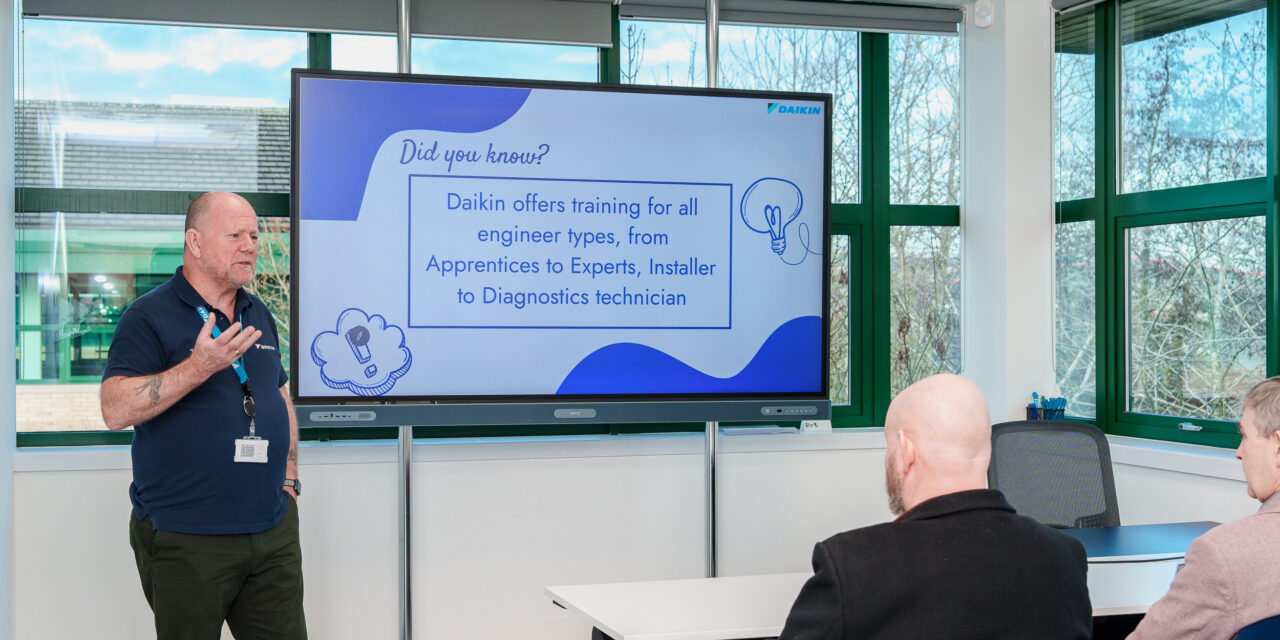
Daikin’s Heat Pump Bootcamp is delivered as an intensive five-day course. It covers Water Regulations assessment, a Level 3 qualification in the installation and maintenance of air source heat pump systems, and hands-on installation experience with Daikin Altherma units. This allows experienced installers to progress quickly, while government funding means the course can be attended free of charge by eligible participants. Support is also provided around the Boiler Upgrade Scheme application process, helping installers understand how to integrate heat pumps into their business from a commercial as well as technical perspective.

Training facilities themselves play an increasingly important role in building confidence. Purpose-built centres that replicate real installation environments give installers the chance to work with full systems, controls and layouts before carrying out installations in customers’ homes. This reduces risk, improves first-time outcomes and helps ensure that new heat pump installers are fully prepared for the practical realities.
Beyond initial training, ongoing support can be just as critical to long-term success. Access to system design assistance, commissioning support and technical backup during early installations allows installers to develop competence and confidence at a steady pace. One-to-one onboarding, help with funding paperwork and guidance on best practice all contribute to a smoother transition into heat pump work.
Diversify to meet demand
From a commercial standpoint, the case for diversification is increasingly strong. Demand for qualified heat pump installers continues to outstrip supply, and the inclusion of air-to-air systems within the Boiler Upgrade Scheme further broadens the market. For many properties, these systems offer a practical and cost-effective route to
low-carbon heating and cooling.
Importantly, upskilling does not require a wholesale change to the way a business operates. Many installers are choosing to complete training, undertake initial installations with manufacturer support in place, then gradually increase the proportion of heat pump work as experience grows. With regulations tightening around fossil fuel heating, investing time in training now is as a logical step towards long-term resilience.
Hamid Salimi is Residential Product Manager at Daikin.