Ed Morris delves into the inner workings of a crucial component in plumbing systems – the thermostatic mixing valve.
While it may seem small and inconspicuous, thermostatic mixing valves (TMVs) play a significant role in maintaining safety, comfort, and efficiency in plumbing systems. A TMV blends cold water with hot water and maintains this at a set constant outlet temperature to ensure safe and comfortable hand washing, showerand bath water temperatures, reducing the risk of scalding.
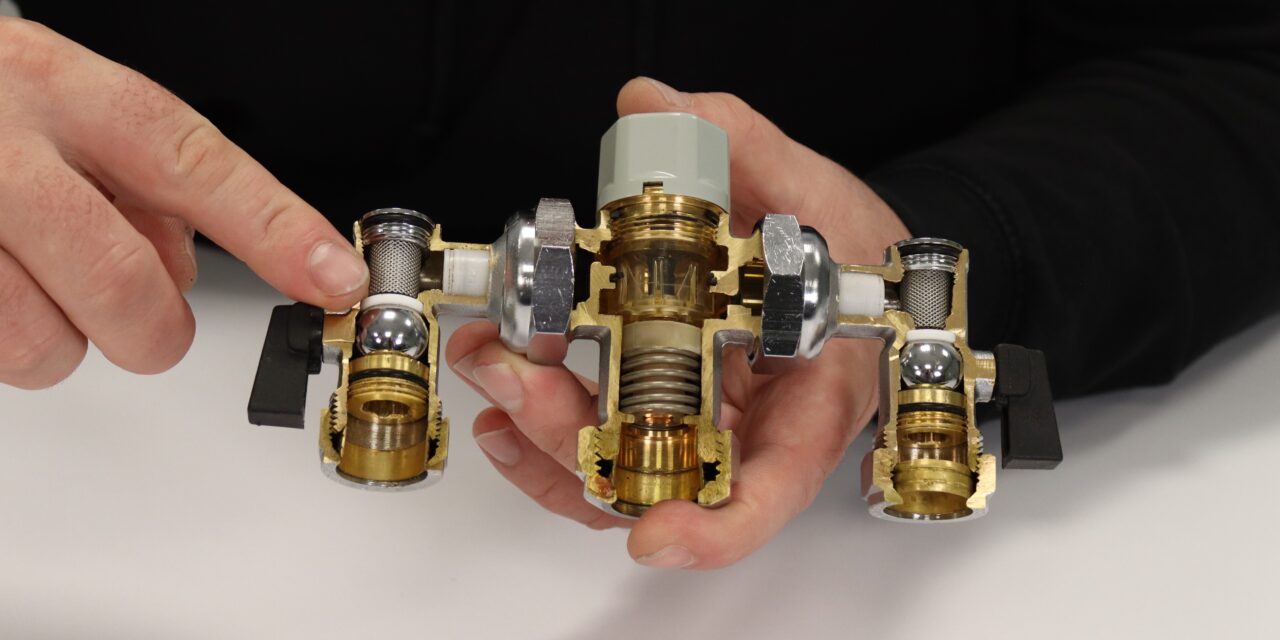
The controlling element of the TMV is a temperature sensor that is fully immersed in the mixed water outlet port. This expands or contracts to maintain the correct proportion of hot and cold water entering the valve.
Ball valve isolation and strainer: A TMV typically includes ball valve isolators on the hot and cold water inlets. These allow for easy maintenance and servicing by enabling the TMV to be isolated from the rest of the system. When closed, they stop the flow of water into the TMV, ensuring safe access for maintenance or repair work.
Before water enters the TMV, it passes through a strainer. The strainer removes any debris or particles present in the water, preventing them from potentially damaging internal components and ensuring longevity. Strainers must be cleaned during servicing to prevent potential blockages from a build-up of debris.
Check valves: Inside the TMV there are check valves on both the hot and cold water inlets. These allow water to flow in only one direction, preventing backflow and maintaining the integrity of the hot and cold water supplies. Ensuring water flows only from the inlets towards the mixing chamber helps to prevent cross-contamination between hot and cold water lines.
Flow conveyor: The flow conveyor is responsible for mixing the hot and cold water streams to achieve the desired outlet temperature. It consists of a chamber where the hot and cold water streams mix together. The size of the flow conveyor and the ratio of hot to cold water flow determine the outlet temperature of the TMV
Thermostat: At the heart of the TMV lies the thermostat, a temperature-sensitive element that regulates the flow of hot and cold water to maintain a constant outlet temperature. The thermostat reacts to changes in the outlet temperature by adjusting the position of the valve within the flow conveyor. If the outlet temperature rises above the set point, the thermostat will adjust the valve to allow more cold water into the mix, effectively lowering the temperature. Conversely, if the outlet temperature drops below the set point, the thermostat will increase the flow of hot water to raise the temperature.
As plumbing standards continue to evolve and safety regulations become increasingly stringent, the importance of TMVs cannot be overstated. Whether in residential homes, healthcare facilities, or commercial buildings, the inclusion of TMVs in plumbing systems exemplifies a commitment to safety, comfort, and efficiency.
Ed Morris is Technical Manager at Altecnic