A recent roundtable hosted by Baxi discussed the challenges and opportunities surrounding the decarbonisation of heat in care homes. HP&R reports.
This summer, Baxi carried out a survey of over 400 care home managers to understand their attitudes towards decarbonising heat. The subsequent report analysed the implications of the findings and included Baxi’s policy recommendations.
The UK’s population of over 85s is set to double between now and 2050, leading to increased demand for care services. Around 94% of the care home managers surveyed expect to have a budget for decarbonisation. However, the research highlighted a number of barriers the sector needs to overcome in order to deliver its decarbonisation ambitions across the approximately 17,000 UK care homes:
- Access to funding
- The need for technical advice and guidance on funding
- Procurement and installation
- Cost and affordability
- The spark gap between electricity and gas prices
- Ongoing running costs.
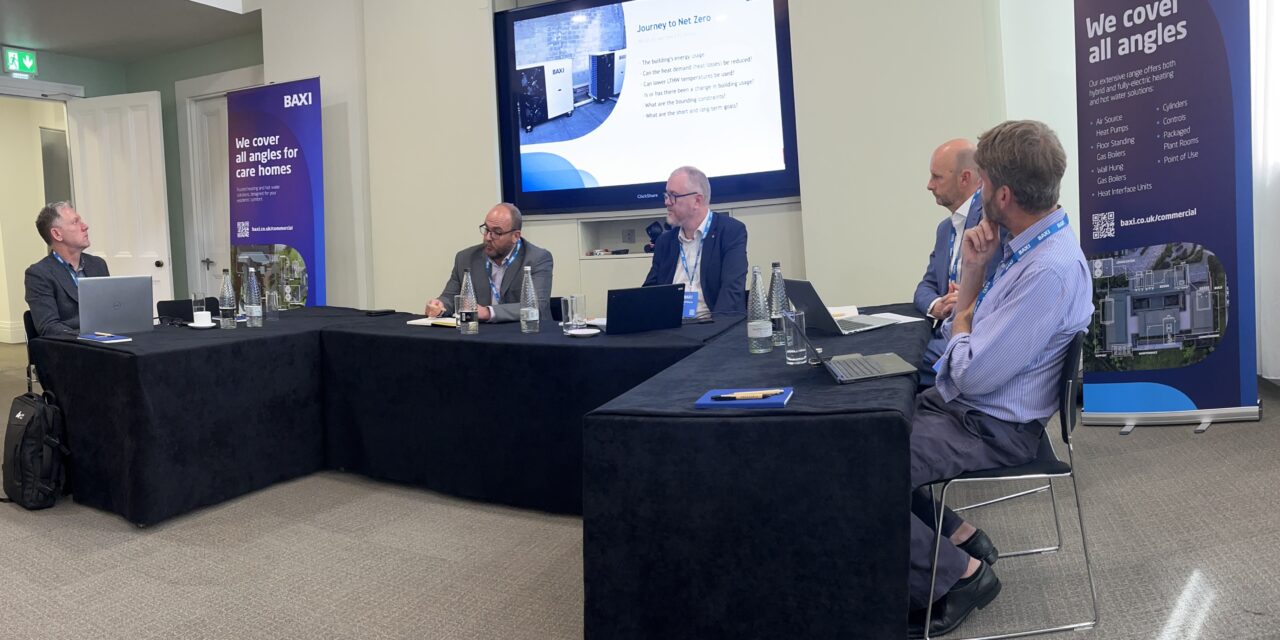
The roundtable was hosted by Jeff House, Baxi’s Director of External Affairs and Policy. It also gave a panel of industry experts the chance to share their perspectives. Taking part were Paul Chambers, Deputy Director of the Public Sector Decarbonisation Scheme at the Department for Energy Security and Net Zero (DESNZ); Nik Smith, Managing Director of specialist renewable energy contractor, Oakes Energy Services; Richard Hilson, Principal Consultant, Health and Sustainability, at technology and data consultancy, Talan; and Andy Green, Head of Technical Solutions at Baxi.
The discussion began with a recap of Baxi’s research, which revealed the opportunity for retrofit, with the majority of survey respondents operating buildings less than 10 years old. This, plus the fact that 42% of care homes rely on fossil-fuel based heating, was said to present an opportunity for the sector to consider heating system upgrades. These would help to significantly reduce a home or estate’s carbon emissions.
Concerns raised by panellists echoed the report’s findings. Among the prominent barriers discussed by the group was the spark gap, with the UK’s high electricity costs offering little incentive to upgrade care home systems.
Legacy challenges from poorly installed and operated heat pumps were also highlighted, prompting the proposal of a standard for the commercial sector that would be key to improving design and installation practices. This, plus quick wins like pipework lagging and switching to a low-temperature heating system, could help operators achieve energy efficiency and decarbonisation.
The panel also discussed the heating system upgrade of a hypothetical 60-bed care home. While the upgrade of a boiler to a fully electric heat pump system would be a significant carbon saver, in the absence of more attractive electricity tariffs and higher operational costs were reported as major obstacles. A hybrid heat pump system delivering 60% of the heating output and a boiler contributing the remaining 40% was a potential option that would provide significant carbon savings while maintaining running cost neutrality.
The report’s full findings can be downloaded at www.baxi.co.uk/commercial